
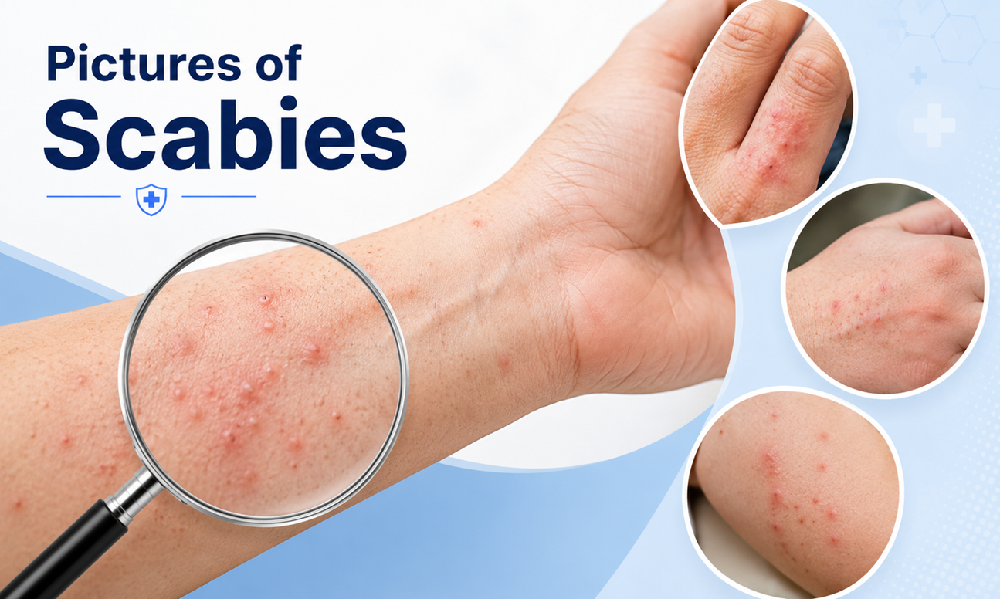
Scabies can resemble eczema, insect bites, pimples, or other itchy rashes. The clues that matter most are intense nighttime itching, the location of the rash, tiny burrows, and whether close contacts are also itching.
Updated for a U.S. audience in 2026
People searching for pictures of scabies are often trying to decide whether a new itchy rash matches the typical appearance of a scabies infestation. Photos can show useful patterns, but scabies does not look identical on every person, and the mites themselves are usually too small to see without magnification.
The classic picture is an intensely itchy rash made of small bumps, sometimes arranged in lines, with thin burrows in areas such as the finger webs, wrists, waist, armpits, buttocks, nipples, or genitals. In infants, older adults, and people with weakened immune systems, the distribution can be different.
Key Takeaways
- Scabies is caused by the human itch mite, Sarcoptes scabiei var. hominis.
- The rash often looks like small itchy bumps or pimples, and itching is commonly worse at night.
- Tiny curved or wavy burrows can appear as short skin-colored, gray, brown, or slightly raised lines.
- Common sites include the spaces between fingers, wrists, elbows, armpits, waist, buttocks, nipples, penis, and other skin folds.
- Crusted scabies looks very different, with thick scales or crusts and a very high number of mites.
- Photos alone cannot confirm scabies. A clinician may use the rash pattern, contact history, dermoscopy, or skin scraping to make the diagnosis.
What Does Scabies Look Like in Pictures?
Scabies usually causes a pimple-like or bumpy rash rather than one large patch. The bumps may be red or pink on lighter skin, while on darker skin they may appear brown, purple, gray, or simply darker than nearby skin.
Scratching can change the appearance quickly. A person may develop excoriations, crusts, scabs, or infected sores on top of the original rash, which can make online photo comparisons less reliable.
| Appearance | What it may look like | Common locations | Useful clue |
| Early scabies rash | Tiny bumps, papules, or pimple-like spots | Finger webs, wrists, waist, armpits | Strong itch, often worse at night |
| Burrows | Short thin, wavy, curved, or thread-like lines | Between fingers, wrists, hands, genitals | May have a tiny bump at one end |
| Scratched scabies | Scabs, raw skin, or crusted scratch marks | Any heavily itchy area | Secondary changes can hide the original rash |
| Crusted scabies | Thick scale, plaques, or crusted skin | Hands, feet, scalp, body folds, widespread skin | Extremely contagious and needs urgent treatment |
What Do Scabies Burrows Look Like?
Burrows are one of the most characteristic signs. They are created when a female mite tunnels just under the upper layer of skin.
A burrow may look like a tiny wavy or curved line only a few millimeters long. It can be difficult to see because scratching, eczema-like inflammation, skin tone, and the small size of the tunnel can hide it.
The spaces between the fingers and the sides of the hands or wrists are classic places to look. Genital skin can also show burrows or small nodules.
Where Does a Scabies Rash Usually Appear?
- between the fingers
- wrists and forearms
- elbows and armpits
- waist and belt line
- buttocks
- around the nipples
- penis and scrotum
- inner thighs and other covered skin folds
In healthy adults, the face and scalp are usually spared. Infants, very young children, older adults, and immunocompromised people can have involvement of the head, neck, palms, or soles.
What Does Scabies Look Like on the Hands?
Hands are one of the most useful places to inspect because scabies mites commonly affect the finger webs, sides of the fingers, wrists, and areas under rings.
Pictures may show tiny bumps, scratch marks, or narrow burrows crossing the web space between two fingers. Repeated hand washing, eczema, or contact dermatitis can make the pattern harder to recognize.
What Does Scabies Look Like on the Body?
On the torso, scabies often creates scattered itchy bumps around the waist, under the breasts, near the belly button, around the buttocks, or in areas where clothing fits closely.
The rash is often symmetrical rather than limited to one isolated patch. That distribution can help distinguish it from a single insect bite, a localized allergic reaction, or a one-sided viral rash.
What Does Scabies Look Like in Children?
Children can develop the same itchy papules and burrows as adults, but infants and young children may have a broader distribution. The palms, soles, scalp, face, and neck can be involved.
Because babies cannot describe nighttime itching, clues may include irritability, poor sleep, scratching, or several family members developing similar symptoms.
What Is Crusted Scabies?
Crusted scabies, previously called Norwegian scabies, is a severe form in which very large numbers of mites are present. The skin can develop thick scales, crusted plaques, fissures, or widespread rough areas rather than only a few small itchy bumps.
It is especially important to recognize because it spreads far more easily than ordinary scabies and can cause outbreaks in long-term care facilities and other group settings.
The CDC notes that crusted scabies is highly contagious and that delayed diagnosis can contribute to outbreaks. See the CDC overview of scabies symptoms and crusted scabies.
What Can Be Mistaken for Scabies in Photos?
- Eczema: Can cause very itchy, scaly, inflamed patches but does not usually create classic mite burrows.
- Contact dermatitis: Often follows exposure to a product, metal, plant, detergent, or another irritant and tends to match the contact area.
- Bedbug or insect bites: Can cause grouped itchy bumps, but the distribution and household exposure pattern differ.
- Folliculitis: Usually centers around hair follicles and may look like small pimples or pustules.
- Herpes or shingles: Can create grouped blisters, burning, or pain rather than the classic generalized nighttime itch of scabies.
- Impetigo: A bacterial infection can produce blisters or sores with characteristic crusting, especially after scratching.
If the rash includes grouped blisters rather than burrows and pimple-like bumps, TwiageHealth’s herpes photos in different stages guide shows how HSV typically changes from tingling to blisters, open sores, and healing.
Does Scabies Always Itch at Night?
Nighttime itching is one of the strongest clues, but it is not an absolute rule. The itch reflects the immune system’s reaction to the mite, eggs, and waste products.
Someone who has never had scabies before may not develop symptoms for several weeks after infestation. A person who has had scabies previously can react much sooner.
How Do Doctors Confirm Scabies?
A clinician often starts with the rash pattern, presence of burrows, nighttime itching, and whether a partner, family member, roommate, or caregiver has similar symptoms.
Dermoscopy can magnify suspicious burrows, and a skin scraping may identify mites, eggs, or mite material under a microscope. A negative scraping does not always rule out scabies because an ordinary infestation may involve only a small number of mites.
How Is Scabies Treated?
Scabies requires a medication that kills the mites. In the United States, prescription 5% permethrin cream is a common first-line treatment. Oral ivermectin may be used in certain situations, including some difficult or crusted cases.
The American Academy of Dermatology lists prescription options including permethrin, spinosad, sulfur preparations, and other treatments depending on age, pregnancy status, severity, and clinical circumstances. See the AAD scabies diagnosis and treatment guide.
Follow the exact application instructions you receive. Treating only the visibly itchy spots can fail because mites may be present on skin that does not yet look abnormal.
Can Skin-Care Sprays or Home Remedies Kill Scabies?
Do not rely on cosmetic sprays, essential oils, household disinfectants, vinegar, bleach, or other home mixtures to treat a scabies infestation. These approaches can irritate the skin and delay effective treatment.
For example, hypochlorous acid spray may have a role in certain skin-care or cleansing routines, but it is not a scabicide and should not replace prescription treatment for scabies.
Do Household Members Need Treatment Too?
Close contacts often need to be treated at the same time, even if they do not yet itch, because symptoms can be delayed.
Clothing, towels, and bedding used during the days before treatment should be handled according to medical guidance. Items that can be washed are typically laundered using hot water and a hot dryer cycle, while nonwashable items can be sealed away for several days.
Why Am I Still Itchy After Scabies Treatment?
Itching can continue after the mites have been killed because the allergic skin reaction takes time to settle. This does not automatically mean treatment failed.
New burrows, new pimple-like lesions, or itching that continues beyond the expected recovery period can be reasons to contact the treating clinician. Reinfection is also possible when close contacts were not treated at the same time.
When Should You See a Doctor?
- the rash is extremely itchy at night and several close contacts are also itching
- you see possible burrows between the fingers or around the wrists
- thick crusted or scaly areas suggest possible crusted scabies
- scratched skin becomes increasingly red, warm, painful, swollen, or drains pus
- a baby, frail older adult, pregnant person, or immunocompromised person may have scabies
- symptoms continue or new lesions appear after treatment
Common Questions About Pictures of Scabies
What does the beginning of scabies look like?
Early scabies may look like tiny itchy bumps or pimples before obvious scratch marks appear. Burrows can be subtle or absent from what you can see.
Can you see scabies mites in a picture?
Usually not with the naked eye. The mites are microscopic. Photos generally show the rash, burrows, or crusting caused by the infestation.
Does scabies look like little red dots?
It can. On lighter skin, bumps may look red or pink. On darker skin, they may appear brown, purple, gray, or darker than surrounding skin.
Can scabies look like eczema?
Yes. Scratching and inflammation can create scaly, eczema-like patches, which is one reason professional diagnosis can be helpful.
Where does scabies usually start?
Common early sites include the finger webs, wrists, hands, waist, armpits, and genital area, but the first noticeable location varies.
The Bottom Line
Pictures of scabies can help you recognize the typical pattern of small intensely itchy bumps, thin burrows, scratch marks, and characteristic body locations. The strongest clue is often not one individual bump but the combination of nighttime itching, distribution, burrows, and similar symptoms in close contacts.
Do not rely on photos alone to decide whether a rash is scabies. Eczema, insect bites, folliculitis, herpes, impetigo, and other conditions can look similar. If scabies is suspected, proper diagnosis and prescription treatment help clear the infestation and prevent it from spreading to others.
Medical Note
This article is for general educational purposes and does not diagnose scabies from appearance alone. A persistent intensely itchy rash, suspected crusted scabies, signs of skin infection, or symptoms affecting a vulnerable person should be evaluated by a qualified health care professional.