
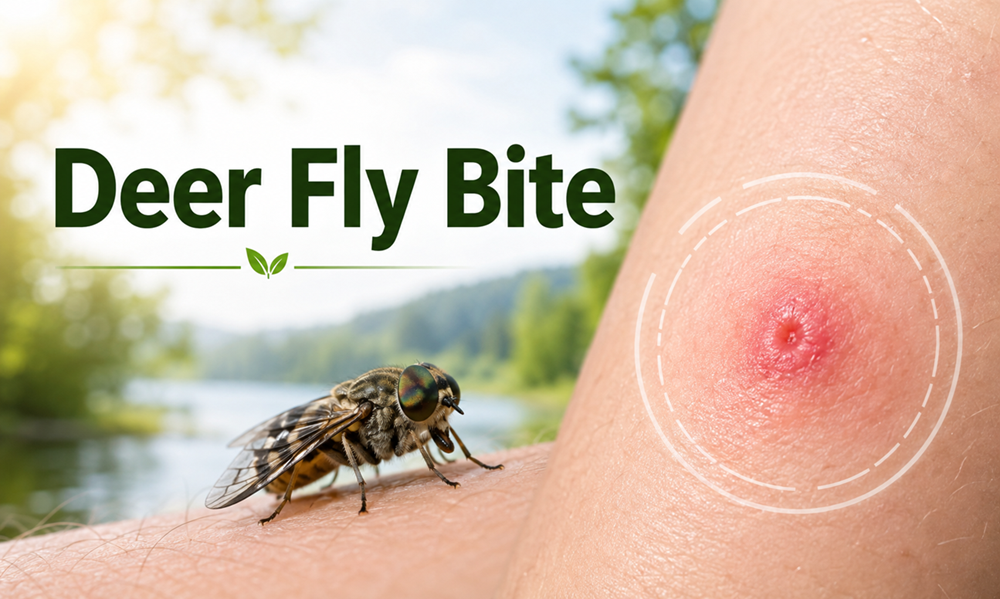
Deer fly bites can be surprisingly painful because the fly cuts the skin rather than piercing it like a mosquito. Most bites heal with simple home care, but increasing swelling, infection, severe allergy symptoms, or fever after a bite deserves more attention.
Updated for a U.S. audience in 2026
A deer fly bite usually causes a sudden sharp or burning pain followed by a red bump, welt, or swollen patch. Unlike mosquitoes, female deer flies use cutting mouthparts to open the skin and feed on pooled blood, which helps explain why the bite often hurts immediately.
Most reactions stay close to the bite and improve over several days. The important exceptions are a large allergic reaction, a skin infection after scratching, or signs of tularemia, a rare bacterial disease that deer flies can transmit in some parts of the United States.
Key Takeaways
- Deer fly bites are often immediately painful and may leave a red bump, welt, small cut, or swollen itchy area.
- Wash the bite with soap and water and use a wrapped cold pack for short periods to reduce pain and swelling.
- Avoid scratching because broken skin can become infected.
- A large local reaction can cause considerable swelling without being the same as anaphylaxis.
- Trouble breathing, throat or tongue swelling, fainting, or rapidly developing whole-body symptoms require emergency care.
- Deer flies can rarely transmit tularemia. Fever, a persistent ulcer at the bite site, swollen lymph nodes, chills, or significant fatigue after exposure should be medically evaluated.
What Does a Deer Fly Bite Look Like?
There is no single appearance, but the bite commonly becomes a raised red or pink welt on lighter skin. On darker skin, inflammation may appear purple, brown, gray, or simply darker than the surrounding area.
Because the fly slices the skin, you may see a tiny central cut, puncture-like mark, or spot of blood. The surrounding area can become warm, itchy, tender, and swollen.
| Feature | Typical deer fly bite | What it can mean |
| Pain | Sharp, burning, or stinging at the moment of the bite | Common local reaction |
| Skin mark | Red bump, welt, or small superficial cut | Typical feeding injury |
| Swelling | Mild to moderate puffiness around the bite | Often inflammatory |
| Itching | May develop after the initial pain | Reaction to saliva and skin irritation |
| Large swelling | A broader swollen area around the bite | Can be a large local reaction |
| Ulcer + fever | Sore that persists with systemic illness | Needs evaluation for tularemia or another infection |
Why Do Deer Fly Bites Hurt So Much?
Female deer flies need blood to support egg production. Their mouthparts cut or slice the surface of the skin, creating a small bleeding area that the fly can feed from.
That mechanical injury makes the bite different from the relatively subtle puncture of a mosquito. Deer fly saliva also contains substances that help keep blood flowing while the insect feeds, and the immune response to those substances can add redness, itching, and swelling.
Where Are Deer Flies Common?
Deer flies are most active outdoors during warmer months and are often found around wetlands, wooded areas, streams, lakes, fields, and places with animals. They are daytime fliers and may repeatedly circle or pursue people.
Exposed skin around the head, neck, shoulders, arms, and legs can be bitten. Wearing a hat and covering more skin can reduce opportunities for the fly to feed.
How Should You Treat a Deer Fly Bite at Home?
Most uncomplicated bites can be managed with basic first aid.
- Move away from the area if deer flies are still active so you are not bitten again.
- Wash the bite gently with soap and water.
- Apply a cold pack wrapped in cloth for about 10 minutes at a time, then give the skin a break before reapplying.
- Avoid scratching or picking at the small wound.
- For itching, an appropriate over-the-counter antihistamine or anti-itch product may help if the label says it is safe for you.
- Monitor the area over the next several days for worsening redness, warmth, pain, swelling, drainage, or red streaks.
MedlinePlus recommends washing insect bites, using wrapped ice in short intervals, and watching for increasing redness, swelling, or pain that could suggest infection. See MedlinePlus first aid for insect bites and stings.
What Can You Put on a Deer Fly Bite?
Cold is the simplest first step. For lingering itch, calamine lotion or 1% hydrocortisone may be reasonable for many adults when used according to the label. An oral antihistamine may help a more noticeable itchy reaction, although some products can cause drowsiness.
Do not put bleach, concentrated essential oils, harsh disinfectants, or other irritating home remedies into the bite. These can damage the skin and make inflammation harder to judge.
If you are comparing skin-care sprays for minor irritation, TwiageHealth’s guide to hypochlorous acid spray explains its role in surface cleansing. A cosmetic skin spray, however, is not a treatment for tularemia, anaphylaxis, or a true bacterial skin infection.
How Long Does a Deer Fly Bite Last?
A mild local reaction often improves over a few days. Pain may settle before the redness or itching completely disappears.
A larger local reaction can remain swollen longer. The trend matters more than the exact number of days: gradual improvement is reassuring, while rapidly worsening pain, heat, redness, or drainage is not.
Deer Fly Bite vs. Wasp Sting: What Is Different?
Both can cause immediate pain and swelling, but they injure the skin differently. A deer fly bites and cuts the skin to feed, while a wasp injects venom through a stinger.
A severe allergic reaction can occur after many types of insect exposure, so breathing difficulty, throat swelling, or faintness should be treated as an emergency regardless of whether the original injury was a bite or sting.
For sting-specific first aid and allergy warning signs, see TwiageHealth’s wasp sting treatment guide.
Can a Deer Fly Bite Cause an Allergic Reaction?
Yes. Some people develop more swelling, redness, hives, or itching because their immune system reacts strongly to insect saliva.
A large swollen area around one bite is uncomfortable but is not automatically anaphylaxis. The emergency signs are symptoms away from the bite that affect breathing, the throat, circulation, or several body systems.
When Is a Deer Fly Bite an Emergency?
Call 911 in the United States if a bite is followed by signs of a severe allergic reaction, especially:
- trouble breathing or wheezing
- swelling of the tongue, lips, face, or throat
- difficulty swallowing or a suddenly hoarse voice
- severe dizziness, fainting, or confusion
- widespread hives together with breathing, stomach, or circulation symptoms
If you have been prescribed epinephrine for insect allergy and symptoms suggest anaphylaxis, use it according to your emergency plan and call 911.
Can Deer Flies Spread Tularemia?
Yes, although this is uncommon. Tularemia is an infection caused by the bacterium Francisella tularensis. People can acquire it through several routes, including tick and deer fly bites, handling infected animals, contaminated water, or inhaling contaminated material.
The CDC confirms that deer flies have transmitted tularemia in the western United States and notes that infections from tick or deer fly bites often appear as ulceroglandular or glandular tularemia. Read the CDC information on how tularemia spreads.
What Does Tularemia After a Deer Fly Bite Look Like?
A simple bite welt does not mean you have tularemia. The concern rises when a person develops systemic symptoms or a persistent ulcer after a relevant exposure.
- fever or chills
- marked fatigue or body aches
- headache
- a skin ulcer at or near the bite site
- swollen and painful lymph nodes near the affected area
Contact a clinician promptly if these symptoms develop after a deer fly bite, particularly if the exposure occurred in an area where tularemia is known to occur. Tularemia is treated with antibiotics, so early recognition matters.
Can a Deer Fly Bite Become Infected?
Yes. The bite leaves a break in the skin, and repeated scratching can introduce bacteria.
Increasing warmth, tenderness, swelling, pus, spreading redness, red streaks, or fever can indicate a secondary skin infection. A clinician may need to distinguish an ordinary infected wound from tularemia or another condition.
How Can You Prevent Deer Fly Bites?
- Wear long sleeves and long pants when practical in areas with heavy fly activity.
- Use a hat to protect the head and neck.
- Use an EPA-registered insect repellent according to the product directions.
- Limit time in areas where deer flies are repeatedly circling or biting.
- Use screens and physical barriers around outdoor resting areas when possible.
- Check exposed skin after outdoor activities and clean any fresh bites promptly.
Common Questions About Deer Fly Bites
Do deer flies leave a stinger?
No. Deer flies bite with cutting mouthparts. There is no stinger to remove after the bite.
Do deer fly bites blister?
They can occasionally produce a small blister or a very swollen welt, although a red painful bump or raised area is more typical.
Why does my deer fly bite keep swelling?
Inflammation can continue building after the initial bite, especially in people who have a strong local reaction. Rapidly worsening swelling with severe pain, fever, or spreading redness should be evaluated.
Can you get Lyme disease from a deer fly?
Deer flies are not the standard vector for Lyme disease. In the United States, Lyme disease is transmitted by infected blacklegged ticks.
Should I take antibiotics after every deer fly bite?
No. Routine deer fly bites do not automatically require antibiotics. Antibiotics are used when a bacterial infection such as tularemia or a secondary skin infection is diagnosed or strongly suspected.
The Bottom Line
A deer fly bite is usually painful right away and may leave a red welt, small superficial cut, itching, or localized swelling. For most people, washing the area, applying cold, avoiding scratching, and using appropriate over-the-counter symptom relief is enough.
Seek emergency care for breathing difficulty, throat swelling, fainting, or other signs of anaphylaxis. Contact a clinician for spreading skin infection or if fever, a persistent ulcer, or swollen lymph nodes develop after the bite, because deer flies can rarely transmit tularemia.
Medical Note
This article is for general educational purposes and is not a substitute for medical advice, diagnosis, or treatment. Severe allergic symptoms, significant infection, or possible tularemia require professional medical evaluation.