
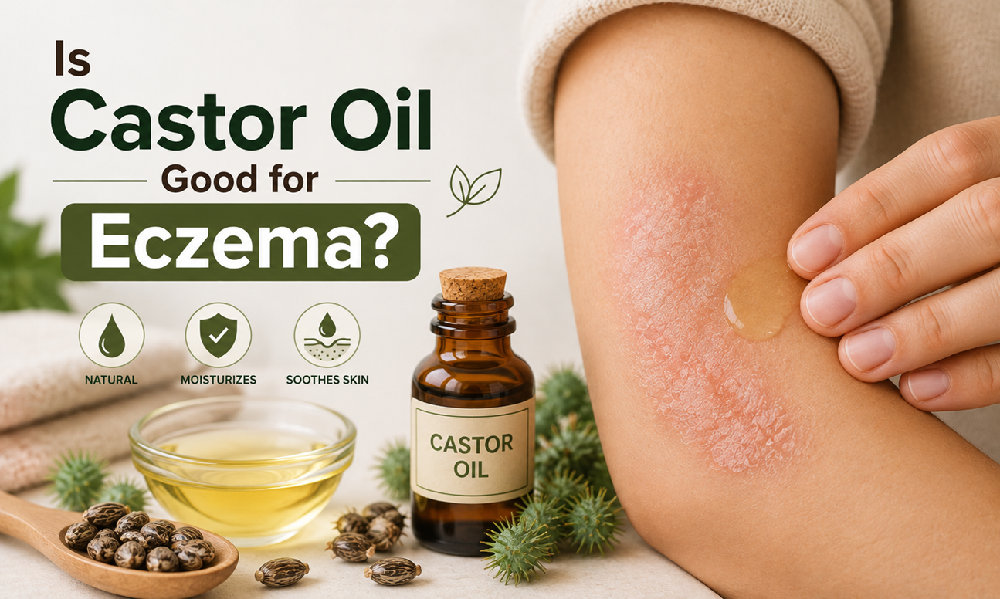
Castor oil can act as a heavy emollient and may make dry eczema-prone skin feel softer, but evidence that it treats eczema itself is limited. For people wondering is castor oil good for eczema, the main potential benefit comes from its ability to coat the skin and reduce moisture loss rather than treating the underlying inflammation. This 2026 U.S.-focused guide explains what castor oil can realistically do, who should avoid it, and how it compares with proven eczema care.
Castor oil is a thick vegetable oil pressed from the seeds of the Ricinus communis plant. It is rich in ricinoleic acid, a fatty acid that gives the oil much of its distinctive texture and skin-conditioning properties. Because eczema commonly involves dryness and a weakened skin barrier, it is understandable that people look to oils as a way to seal in moisture.
The important distinction is that moisturizing dry skin is not the same as treating the inflammation that drives eczema. Castor oil may help some people feel less dry or tight, but high-quality clinical evidence specifically showing that castor oil improves atopic dermatitis is limited. Current dermatology guidelines place far stronger evidence behind regular moisturizers and, when needed, prescription or over-the-counter anti-inflammatory treatment. The American Academy of Dermatology lists moisturizers and several topical therapies among evidence-based treatments for atopic dermatitis.
Key Takeaways
- Castor oil may help reduce the feeling of dryness by forming an oily layer on the skin, but it is not a proven eczema medication.
- There is limited direct clinical evidence that castor oil reduces eczema inflammation, itching, or flare frequency.
- Ricinoleic acid is the major fatty acid in castor oil and may have useful emollient properties, but laboratory or theoretical benefits should not be confused with proven eczema treatment.
- Castor oil can trigger irritation or allergic contact dermatitis in some people, including people with already-sensitive skin.
- If you want to try it, patch test a small area first and avoid applying it to obviously infected, weeping, or severely inflamed skin unless a clinician advises otherwise.
- For most people with eczema, a fragrance-free cream or ointment with a strong safety record is a more predictable first-line moisturizer than a botanical oil.
Can castor oil actually help eczema?
It may help with one part of eczema care: dryness. Oils can create an occlusive or semi-occlusive layer that slows water loss from the outer skin. If your eczema is calm but the skin feels rough, tight, or flaky, a small amount of castor oil applied over damp skin or over a moisturizer may make the area feel softer.
What castor oil has not been clearly shown to do is control the underlying immune-driven inflammation of atopic dermatitis. That is why it should be viewed, at most, as a supportive skin-care product rather than a substitute for eczema therapy.
What does the research say about castor oil for eczema?
Research on castor oil in dermatology is broader than research on eczema specifically. Castor oil has been used as an emollient in cosmetics, skin preparations, and some medical products. A 2026 dermatology review described potential skin uses but also emphasized that more clinical investigation is needed to establish efficacy and optimal use.
That means claims such as ‘anti-inflammatory,’ ‘healing,’ or ‘eczema-clearing’ should be interpreted cautiously. A biologically plausible effect is not the same as a treatment benefit demonstrated in well-designed trials involving people with eczema. A 2026 PubMed-indexed review summarizes the dermatologic uses and limitations of castor oil.
What is ricinoleic acid, and why is it mentioned so often?
Ricinoleic acid is the predominant fatty acid in castor oil. It helps give the oil its thick, lubricating consistency and is one reason castor oil works well as a skin-conditioning ingredient. Some laboratory and pharmacologic findings have led to interest in anti-inflammatory properties, but there is not enough eczema-specific clinical evidence to say that ricinoleic acid treats an eczema flare.
Ricinoleic acid can also be relevant for the opposite reason: rare allergic reactions to castor oil or castor-derived ingredients have been reported. People with eczema already have reactive skin, so a natural ingredient is not automatically a non-irritating ingredient.
How does castor oil compare with a regular eczema moisturizer?
| Option | Main benefit | Evidence for eczema | Practical drawback |
| Castor oil | Helps coat skin and reduce a dry, tight feeling | Limited direct evidence | Can feel very sticky and may irritate or trigger allergy in some people |
| Petrolatum ointment | Strong occlusive barrier that reduces water loss | Widely used in eczema skin care | Greasy texture |
| Fragrance-free cream | Adds moisture and barrier-supporting ingredients | Well supported as routine eczema care | May need frequent reapplication |
| Prescription anti-inflammatory treatment | Targets eczema inflammation and itching | Evidence-based when clinically appropriate | Requires correct drug choice and instructions |
Is castor oil better than coconut oil for eczema?
There is not enough evidence to name castor oil as the better eczema oil. Coconut oil has been studied more directly in some skin-barrier and atopic dermatitis settings, while castor oil evidence for eczema remains sparse. Even so, neither oil should automatically replace a fragrance-free cream, ointment, or prescribed eczema medication.
Individual tolerance also matters. One person may find a plant oil soothing while another develops burning, itching, follicle irritation, or contact dermatitis. The best moisturizer is one that you can use consistently without irritation and that leaves the skin comfortable.
Can castor oil make eczema worse?
Yes. Any topical product can worsen eczema if it irritates the skin or triggers an allergic contact reaction. Castor oil and castor-derived ingredients have been linked to allergic contact dermatitis in published case reports. Symptoms can include increased redness, itching, burning, swelling, scaling, or a rash that spreads beyond the original eczema area.
If your eczema becomes noticeably itchier or redder after using castor oil, wash the product off gently and stop using it. Persistent or severe reactions should be evaluated by a clinician, especially if the rash is blistering, swollen, painful, or involving the eyes or face.
How should you patch test castor oil before using it?
A home patch test cannot rule out every allergy, but it may help identify obvious irritation before you cover a large eczema-prone area.
- Choose a small area of intact skin, such as the inner forearm.
- Apply a very small amount of the same castor oil product you plan to use elsewhere.
- Leave the area alone and watch for redness, burning, itching, swelling, or a new rash over the next day or two.
- Do not continue using the product if the test area reacts.
- If you have a history of severe contact allergies, widespread eczema, or previous reactions to cosmetics, ask a dermatologist whether formal patch testing is more appropriate.
What is the safest way to use castor oil on eczema-prone skin?
If your skin tolerates castor oil and you want to use it as an emollient, keep the routine simple. Choose a product without fragrance or unnecessary essential oils, because fragrance is a common irritant for eczema-prone skin.
- Use it on intact skin rather than open, cracked, bleeding, or infected areas.
- Apply only a thin layer because castor oil is unusually thick.
- Consider applying it after a fragrance-free moisturizer rather than using it as your only moisturizer.
- Use it after a short lukewarm bath or shower while the skin is still slightly damp.
- Stop if you develop burning, worsening itching, redness, swelling, or a spreading rash.
The American Academy of Dermatology recommends applying moisturizer soon after bathing to help trap water in eczema-prone skin. See the AAD’s current atopic dermatitis skin-care recommendations.
Should castor oil go before or after eczema medication?
If you have a prescribed topical medication, follow the instructions from your dermatologist or pharmacist. In general, thick oils can form a barrier on the skin, so putting them on first may interfere with how another topical product spreads or reaches the skin.
A common approach is to apply the medicated treatment as directed, allow it to absorb, and use moisturizer or an occlusive layer according to the treatment plan. Because different prescriptions have different instructions, it is better to confirm the order with the prescriber than to assume castor oil should always be layered the same way.
Can you use castor oil during an eczema flare?
A mild dry flare may tolerate a bland emollient, but an actively red, intensely itchy, swollen, cracked, or weeping flare often needs more than an oil. Using castor oil alone can delay effective treatment if the skin actually needs an anti-inflammatory medication or evaluation for infection.
If a flare is rapidly worsening, waking you from sleep, covering a large area, or not improving with your usual plan, contact a health care professional. If the skin is warm, increasingly painful, crusted, draining pus, or accompanied by fever, infection should be considered.
Is castor oil safe for eczema on the face or eyelids?
Facial and eyelid skin is thin and particularly sensitive. Castor oil can migrate into the eyes and may cause irritation, and facial eczema can overlap with allergic contact dermatitis, seborrheic dermatitis, or other conditions.
For eyelid eczema, it is safer to use products specifically recommended for that area and to ask a clinician before applying heavy oils or prescription medications close to the eyes. Do not put castor oil directly into the eye.
What about castor oil for baby or child eczema?
Children with eczema generally do best with a simple skin-care routine built around short lukewarm baths, fragrance-free cleansers when needed, and a thick fragrance-free moisturizer. Because babies can have highly reactive skin and may rub treated areas into their eyes or mouth, parents should check with a pediatrician or dermatologist before adding castor oil or other botanical products.
A product being natural does not make it automatically safer for infants. The fewer unnecessary ingredients in a child’s routine, the easier it is to identify what is helping or causing irritation.
What eczema treatments have stronger evidence than castor oil?
Treatment depends on age, eczema severity, body location, infection risk, and how much the condition affects sleep and daily life. Evidence-based care may include:
- regular use of fragrance-free creams or ointments
- topical corticosteroids used at the appropriate strength and duration
- topical calcineurin inhibitors
- other nonsteroid topical prescriptions, depending on age and severity
- phototherapy for selected patients
- systemic or biologic treatment for moderate-to-severe disease when appropriate
- trigger reduction and treatment of bacterial or viral skin infections when present
Castor oil can potentially sit alongside an effective plan if your skin tolerates it, but it should not replace treatment that is controlling inflammation and preventing flares.
When should you see a dermatologist about eczema?
- itching or rash is interfering with sleep, school, work, or daily activities
- eczema is spreading or becoming more severe despite regular moisturizing
- skin repeatedly cracks, bleeds, or becomes painful
- you see pus, yellow crust, increasing warmth, swelling, or other possible signs of infection
- you develop clusters of painful blisters or rapidly worsening facial eczema
- you are relying on multiple home remedies without getting control of the condition
- you suspect that skin-care products, cosmetics, fragrances, or oils are causing allergic contact dermatitis
Common Questions About Castor Oil and Eczema
Does castor oil stop eczema itching?
It may make very dry skin feel more comfortable, which can indirectly reduce some dryness-related itch. There is not strong clinical evidence that castor oil reliably treats the inflammatory itch of eczema.
Can castor oil heal eczema permanently?
No. Eczema is a chronic inflammatory skin condition that tends to flare and improve over time. Castor oil does not cure eczema.
Can I leave castor oil on eczema overnight?
If your skin has tolerated a patch test and the area is intact, a thin layer may be left on like another emollient. Stop if it causes irritation, and avoid soaking severely inflamed skin in a thick oil layer without medical advice.
Should I mix castor oil with another oil?
Mixing oils is not necessary and adds another ingredient that could irritate sensitive skin. A simpler routine is usually easier to tolerate and easier to troubleshoot.
Is cold-pressed castor oil better for eczema?
There is no good eczema-specific evidence showing that cold-pressed castor oil produces better clinical outcomes than other properly manufactured castor oil. Purity and the absence of fragrance or irritating additives may be more practical considerations.
Can castor oil replace hydrocortisone?
No. Castor oil is an emollient, while hydrocortisone is an anti-inflammatory corticosteroid. If hydrocortisone or another medication has been recommended for an eczema flare, do not replace it with castor oil without discussing the change with a clinician.
What is the bottom line on castor oil for eczema?
Castor oil can be useful as a heavy moisturizing oil for some people with dry, eczema-prone skin, but the evidence does not support calling it an eczema treatment. Its main practical benefit is helping coat the skin and reduce a dry or tight feeling. The main drawbacks are its sticky texture, limited eczema-specific research, and the possibility of irritation or allergic contact dermatitis.
If you want to try it, patch test first, use a thin layer on intact skin, choose a fragrance-free product, and keep proven eczema care at the center of your routine. Moderate, severe, infected, or persistent eczema deserves medical evaluation rather than relying on castor oil alone.
Medical Note
This article is for general educational purposes and is not a substitute for medical advice, diagnosis, or treatment. People with severe, infected, rapidly worsening, or persistent eczema should seek care from a qualified health care professional.
Editorial Sources
This 2026 update was informed by current guidance from the American Academy of Dermatology and recent PubMed-indexed dermatology literature on castor oil. The HealthCentral reference was used for search intent and topic coverage only.