
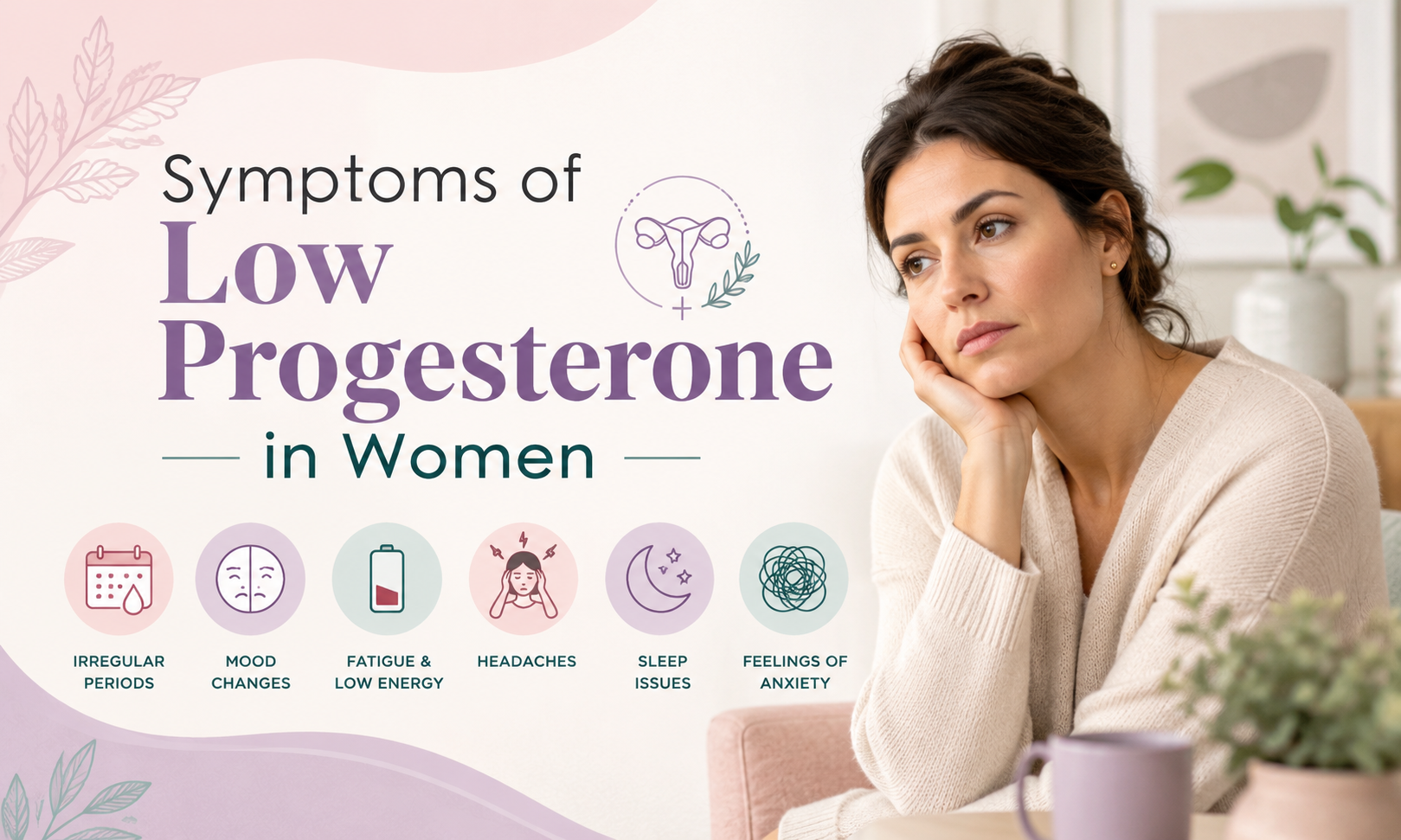
Low progesterone can accompany missed ovulation, irregular cycles, fertility problems, perimenopause, and some pregnancy complications. But many symptoms blamed on “low progesterone” are nonspecific, so the pattern of your cycle and the timing of testing matter more than any single symptom.
| Important: Symptoms cannot diagnose low progesterone by themselves. Progesterone changes throughout the menstrual cycle and pregnancy. Abnormal bleeding, infertility, or pregnancy symptoms should be evaluated in context rather than treated with over-the-counter hormone products on your own. |
Progesterone is one of the main hormones that changes across the menstrual cycle, which is why symptoms of low progesterone in women need to be understood in the context of cycle timing. Before ovulation, progesterone is usually low. After an egg is released, the corpus luteum in the ovary produces much more progesterone. That rise helps transform the uterine lining so it can support implantation. If pregnancy does not occur, progesterone falls and menstruation begins.
Because progesterone is supposed to be low during part of every normal cycle, the phrase “low progesterone” only makes sense when it is tied to timing. A level that would be expected before ovulation could be unexpectedly low about a week after ovulation. In pregnancy, the meaning is different again.
The most useful signs of a possible progesterone problem therefore tend to be reproductive patterns: not ovulating regularly, irregular or absent periods, an unusually short interval between ovulation and the next period, abnormal bleeding, or difficulty conceiving. Symptoms such as poor sleep, headaches, mood changes, bloating, and breast tenderness can occur alongside hormonal shifts, but they are not specific enough to prove a progesterone deficiency.
Key Takeaways
- The clearest clue to low progesterone outside pregnancy is often a problem with ovulation. If ovulation does not happen, the ovary does not form a normal corpus luteum and progesterone does not rise as expected.
- Irregular periods, missed periods, short cycles, and premenstrual spotting can occur when ovulation or luteal-phase function is abnormal, but these symptoms have many other causes.
- Mood changes, sleep problems, headaches, breast tenderness, bloating, and low libido are not reliable standalone signs of low progesterone.
- A progesterone blood test must be interpreted according to where you are in the menstrual cycle. For ovulation assessment, testing is commonly timed about one week before the expected next period.
- A single progesterone value can help show that ovulation occurred, but it cannot reliably diagnose an isolated luteal-phase deficiency because progesterone is released in pulses and can change substantially within hours.
- During pregnancy, low progesterone can be associated with miscarriage or ectopic pregnancy, but a low value may be a sign that a pregnancy is not developing normally rather than proof that progesterone deficiency caused the problem.
- Treatment depends on the underlying cause. Thyroid disease, elevated prolactin, PCOS, hypothalamic causes, perimenopause, and fertility treatment all require different approaches.
What Does Progesterone Do in a Woman’s Body?
Progesterone is produced mainly by the corpus luteum after ovulation. Its best-established roles are in the menstrual cycle and reproduction. It prepares the endometrium for implantation and helps support early pregnancy until the placenta becomes the major source of progesterone.
If pregnancy does not occur, the corpus luteum breaks down. Progesterone and estrogen decline, and the uterine lining is shed during the next period. This rise-and-fall pattern is normal physiology, not a hormone imbalance.
Progesterone also has effects in the brain, breasts, and other tissues, which is one reason people connect it with mood, sleep, headaches, or breast symptoms. However, those symptoms are influenced by many hormones and nonhormonal factors, so they should not be used as a home diagnostic test.
For a current explanation of how progesterone testing is used in the United States, see the MedlinePlus progesterone test overview.
What Are the Most Meaningful Symptoms of Low Progesterone?
There is no unique symptom that means progesterone is low. The strongest clues usually come from menstrual and fertility patterns that suggest ovulation is absent, inconsistent, or followed by an unusually short luteal phase.
| Possible sign | Why progesterone may be involved | Why it is not diagnostic |
| Irregular periods | Irregular ovulation can mean progesterone does not rise normally after ovulation. | PCOS, thyroid disease, high prolactin, perimenopause, weight changes, stress-related hypothalamic dysfunction, medications, and pregnancy can also alter cycles. |
| Missed periods | Anovulation produces little luteal progesterone. | Amenorrhea has many possible causes and always needs context. |
| Short interval after ovulation | A luteal phase of about 10 days or less may raise concern for abnormal luteal function. | Short luteal phases can also occur occasionally in women with otherwise normal fertility. |
| Spotting before a period | Premenstrual spotting has been associated with abnormal luteal function. | Fibroids, polyps, cervix problems, contraception, infection, pregnancy, and other causes can also produce spotting. |
| Difficulty conceiving | Ovulation and adequate progesterone exposure are necessary for normal implantation. | Infertility may arise from egg quality, age, sperm factors, blocked tubes, endometriosis, uterine factors, or many other causes. |
| Pregnancy bleeding or pain | Low progesterone may occur when an early pregnancy is not developing normally. | Bleeding and pain can occur with viable pregnancy, miscarriage, or ectopic pregnancy and should not be diagnosed from progesterone alone. |
Can Low Progesterone Cause Irregular or Missed Periods?
Yes, but the sequence is often misunderstood. In many women, the primary problem is not that progesterone mysteriously fell first. The more common issue is that ovulation did not occur normally. Without ovulation, there is no normal corpus luteum to produce the expected luteal-phase progesterone rise.
This is common in conditions that interfere with ovulation, including PCOS, some thyroid disorders, elevated prolactin, perimenopause, and hypothalamic dysfunction related to low energy availability, major weight change, or excessive exercise.
When ovulation is inconsistent, bleeding can become unpredictable. Periods may be widely spaced, skipped, unusually heavy, or difficult to distinguish from breakthrough bleeding. Because prolonged anovulation can expose the uterine lining to estrogen without enough progesterone, persistent irregular bleeding deserves medical evaluation.
Can Low Progesterone Cause Spotting Before Your Period?
Premenstrual spotting is sometimes associated with a short or abnormal luteal phase. If progesterone support of the uterine lining falls earlier than expected, bleeding may start before the full menstrual flow.
But spotting is not specific to progesterone. Hormonal contraception, uterine polyps, fibroids, cervix irritation, infection, pregnancy, perimenopause, and other gynecologic causes can produce the same symptom.
If spotting is new, recurrent, occurs after sex, becomes heavier, or appears after menopause, do not assume it is a hormone imbalance. Those patterns need appropriate evaluation.
Does a Short Menstrual Cycle Mean Progesterone Is Low?
Not necessarily. Cycle length is influenced by both the follicular phase before ovulation and the luteal phase after ovulation. A short overall cycle can happen because ovulation occurred earlier, because the luteal phase was short, or because bleeding was not actually a normal period.
The American Society for Reproductive Medicine notes that a typical luteal phase is often about 12 to 14 days, with normal variation. A luteal phase of 10 days or less can raise the possibility of luteal-phase deficiency in the right clinical setting.
However, short luteal phases can also appear occasionally in women with normal fertility. That is one reason cycle tracking alone cannot prove a progesterone disorder.
The American Society for Reproductive Medicine’s luteal-phase deficiency committee opinion explains why luteal-phase testing and diagnosis remain more complicated than a single progesterone cutoff.
Can Low Progesterone Cause Infertility?
Progesterone is necessary for normal implantation and early pregnancy, so inadequate progesterone exposure is biologically relevant to fertility. But the clinical question is more complicated than saying that a single low progesterone level causes infertility.
A low luteal progesterone value may reflect a cycle in which ovulation did not occur, occurred later than expected, or produced a corpus luteum that is functioning differently. Those findings can accompany underlying ovulatory disorders that themselves reduce fertility.
ASRM also cautions that isolated luteal-phase deficiency has not been proven to be a consistent independent cause of infertility or recurrent pregnancy loss in natural cycles. No single clinical test currently serves as a reliable gold standard for diagnosing isolated luteal-phase deficiency.
What Symptoms Might Appear With Low Progesterone but Are Less Specific?
Many online lists include mood swings, anxiety, insomnia, headaches, breast tenderness, bloating, low libido, and fatigue. These symptoms can occur during times when progesterone and estrogen are changing, especially before a period or during perimenopause, but they do not identify progesterone as the cause.
Mood changes or irritability: Premenstrual mood symptoms can reflect sensitivity to normal hormonal fluctuations. Depression, anxiety disorders, sleep loss, thyroid disease, medications, and life stress can look similar.
Trouble sleeping: Sleep often becomes more disrupted during perimenopause, but hot flashes, anxiety, sleep apnea, restless legs, alcohol, medications, and insomnia disorders are common alternative causes.
Headaches or menstrual migraine: Hormone withdrawal around menstruation can trigger migraine in susceptible women, but the change involves estrogen and progesterone rather than a simple isolated progesterone deficiency.
Breast tenderness: Breast tissue is hormone-sensitive and can become sore before menstruation or with hormone therapy. Breast tenderness by itself does not tell you which hormone is high or low.
Bloating: Fluid shifts and gastrointestinal changes can occur around the menstrual cycle, but diet, constipation, IBS, medications, and many other factors are more common explanations.
Low libido: Sexual desire is shaped by relationship factors, stress, sleep, medications, pain, estrogen levels, testosterone, mental health, and other influences. Progesterone alone cannot explain most cases.
What Does Low Progesterone Look Like in Perimenopause?
Perimenopause is one of the most common situations in which progesterone becomes less predictable. As the ovaries age, ovulation happens less consistently. Cycles without ovulation do not produce a normal luteal-phase progesterone rise.
The result may be shorter cycles at first, skipped periods later, unpredictable bleeding, or episodes of heavier bleeding. At the same time, estrogen can swing widely, which is why perimenopause symptoms cannot be reduced to a simple story of “low progesterone.”
Hot flashes, night sweats, sleep disruption, vaginal dryness, mood changes, and migraine patterns are all influenced by the broader menopausal transition. If symptoms are affecting quality of life, a clinician can help determine whether treatment should target bleeding, vasomotor symptoms, sleep, contraception, or another specific problem.
What Does Low Progesterone Mean During Pregnancy?
Pregnancy is a separate situation. Progesterone should rise to help maintain the uterine lining and support early pregnancy. A low progesterone result can be associated with an early pregnancy that is not developing normally, including miscarriage or ectopic pregnancy.
But the direction of cause and effect is important. In some failing pregnancies, progesterone falls because the pregnancy is already not progressing normally. A low level therefore does not automatically prove that lack of progesterone caused the pregnancy loss.
Clinicians may combine serial hCG measurements, ultrasound, symptoms, gestational age, and sometimes progesterone testing to understand what is happening. One progesterone value should not be used at home to decide whether a pregnancy is viable.
Which Pregnancy Symptoms Need Prompt Medical Care?
Contact a healthcare professional promptly for bleeding or significant cramping in pregnancy. Seek urgent or emergency evaluation for symptoms that can occur with ectopic pregnancy or internal bleeding, including:
- Severe or one-sided pelvic or abdominal pain.
- Shoulder pain with abdominal or pelvic symptoms.
- Fainting, marked dizziness, or unusual weakness.
- Heavy vaginal bleeding.
- Severe pain that is rapidly worsening.
What Causes Low Progesterone?
Outside pregnancy, low progesterone most often reflects a problem with ovulation or the timing of the test. Possible contributors include:
- Anovulation, meaning an egg was not released during that cycle.
- PCOS, which commonly causes irregular or absent ovulation.
- Perimenopause, when ovulation becomes less predictable.
- Thyroid disorders that interfere with normal reproductive hormone signaling.
- Elevated prolactin, which can suppress ovulation.
- Hypothalamic dysfunction related to low energy availability, major weight loss, undernutrition, or excessive exercise.
- Certain medications or medical conditions that disrupt the hypothalamic-pituitary-ovarian system.
- A blood test drawn at the wrong point in the menstrual cycle.
Age also matters. Luteal hormone production can change during the later reproductive years, but a low value still needs to be interpreted with cycle timing and the reason for testing.
Is Stress Really a Direct Cause of Low Progesterone?
Stress is often described online as if cortisol simply “steals” progesterone. That explanation is too simplistic for clinical use. Severe physiologic or psychological stress can interfere with the brain signals that regulate ovulation, and disrupted ovulation can then lead to lower luteal progesterone.
In other words, the better-supported pathway is often through the hypothalamic-pituitary-ovarian axis and ovulation rather than a simple hormone-depletion mechanism. If stress coincides with missed periods, substantial weight change, under-eating, or intense exercise, clinicians may evaluate for hypothalamic causes.
How Is Low Progesterone Tested?
A serum progesterone test measures progesterone in the blood. The result is only meaningful when the clinician knows why it was ordered and where you are in the menstrual cycle.
When the goal is to confirm ovulation, testing is often done about one week before the expected next menstrual period. This is more accurate than automatically testing everyone on cycle day 21 because not every woman ovulates on day 14.
For example, someone with a 35-day cycle may ovulate much later than someone with a 28-day cycle. A day-21 progesterone test could be mistimed and look “low” simply because ovulation had not happened yet.
What Progesterone Level Confirms Ovulation?
ASRM notes that a luteal serum progesterone value above 3 ng/mL can be used as evidence that ovulation occurred. That does not mean 3 ng/mL is the target for fertility, and it does not establish that the entire luteal phase produced an ideal amount of progesterone.
Progesterone is secreted in pulses. In normally ovulating women, levels can change several-fold over a short period. As a result, a single blood draw is much better at answering “Did ovulation likely occur?” than “Was progesterone adequate every day of the luteal phase?”
There is no universally accepted single progesterone cutoff that proves a natural cycle has normal or fertile luteal function.
Can You Test Progesterone at Home?
Home fertility tools may estimate ovulation using urinary LH or progesterone metabolites, but they do not replace a medical evaluation for abnormal bleeding, infertility, or recurrent pregnancy problems.
An LH surge predicts that ovulation may occur soon. It does not prove that an egg was released. Some urine-based tests look for pregnanediol glucuronide, a progesterone metabolite, to provide additional information after suspected ovulation. Results still need context, particularly in irregular cycles.
If you have been using repeated home tests because you are worried about a hormone deficiency, bring the records to your clinician rather than increasing supplements on your own.
What Other Tests Might a Doctor Order?
Progesterone is often only one part of the workup. Depending on the symptoms, clinicians may also consider:
- A pregnancy test.
- Thyroid-stimulating hormone testing.
- Prolactin testing.
- FSH, LH, or estradiol in selected situations.
- Pelvic ultrasound.
- Evaluation for PCOS or other causes of anovulation.
- A complete blood count when bleeding is heavy or anemia is possible.
- A broader infertility evaluation when pregnancy has not occurred after the recommended period of trying.
When Should You Seek a Fertility Evaluation?
In the United States, infertility evaluation is generally appropriate after 12 months of regular unprotected intercourse without pregnancy when the woman is younger than 35, and after 6 months when she is 35 or older. Evaluation may begin sooner when there are irregular or absent periods, known reproductive conditions, or other factors that could affect fertility.
A progesterone test may be part of that evaluation because it can help assess whether ovulation occurred, but fertility cannot be judged from progesterone alone. Ovulation, ovarian reserve, the uterus and fallopian tubes, age, and sperm factors all matter.
How Is Low Progesterone Treated?
Treatment should target the reason progesterone is low. If the main issue is anovulation from a thyroid disorder or elevated prolactin, correcting that condition may restore more normal cycles. If PCOS is causing irregular ovulation, treatment depends on whether the goal is cycle control, protection of the uterine lining, contraception, or pregnancy.
Prescription progesterone or another progestogen is used in several legitimate clinical settings. These include inducing withdrawal bleeding in some women with amenorrhea, protecting the uterine lining when systemic estrogen therapy is used in a person with a uterus, and supporting the luteal phase in many assisted-reproduction protocols.
Progesterone is not automatically indicated for every symptom on an online low-progesterone list. The form, dose, route, and timing differ according to the medical purpose.
For current U.S. medication information, see MedlinePlus information on prescription progesterone.
Should You Use an Over-the-Counter Progesterone Cream?
Do not use an over-the-counter or compounded hormone product as a substitute for diagnosis. A symptom such as irregular bleeding may come from pregnancy, PCOS, thyroid disease, fibroids, perimenopause, or another condition that needs a different treatment.
Hormone exposure also has safety considerations. Prescription progesterone and progestogens can cause side effects and may be inappropriate in some people with unexplained bleeding, certain cancers, liver disease, or other medical histories.
If you are considering progesterone because of fertility concerns, pregnancy symptoms, or menopausal hormone therapy, discuss the goal with a clinician first. The evidence and dosing are specific to the situation.
Does Low Progesterone Always Mean “Estrogen Dominance”?
“Estrogen dominance” is a popular wellness term, but it is not a single standardized medical diagnosis with one accepted laboratory cutoff. In some clinical situations, the real issue is unopposed estrogen exposure because ovulation is not occurring and progesterone is therefore not being produced normally.
That concept is important in chronic anovulation because persistent estrogen stimulation without adequate progestogen exposure can increase the risk of endometrial hyperplasia. But it should not be used as a catch-all explanation for bloating, mood symptoms, breast tenderness, or weight changes without a proper evaluation.
What Symptoms Should Make You Schedule an Appointment?
- Periods that have become persistently irregular or have stopped.
- Frequent spotting or bleeding between periods.
- Very heavy or prolonged bleeding.
- Difficulty getting pregnant.
- Repeated cycles in which ovulation appears absent.
- New bleeding after menopause.
- Pregnancy bleeding or pain.
- Symptoms of thyroid disease, elevated prolactin, or significant unexplained weight change along with menstrual changes.
Questions Women Often Ask About Low Progesterone
Can you have low progesterone and still get a regular period?
Yes. Progesterone varies from cycle to cycle, and an occasional short or lower-progesterone luteal phase can occur even in women with regular cycles. Regular bleeding also does not always prove that ovulation occurred normally every month.
Does low progesterone cause weight gain?
There is no reliable way to diagnose low progesterone from weight gain. Weight can change with age, diet, activity, sleep, medications, thyroid disease, insulin resistance, fluid retention, and the menopausal transition. A progesterone test is not a routine weight-gain test.
Does low progesterone cause anxiety?
Hormonal fluctuations may influence mood in susceptible women, especially around menstruation and perimenopause, but anxiety is not specific to low progesterone. Persistent anxiety should be evaluated on its own rather than attributed to one hormone.
Can low progesterone cause insomnia?
Sleep disruption can occur during perimenopause and other hormonal transitions, but insomnia has many causes. Hot flashes, sleep apnea, restless legs, depression, anxiety, medications, caffeine, alcohol, and behavioral insomnia are common alternatives.
Can low progesterone cause breast tenderness?
Breast tenderness can fluctuate with reproductive hormones, but it does not identify a progesterone deficiency. It is common before periods and can also occur with pregnancy, hormone therapy, medications, or benign breast conditions.
Can low progesterone cause miscarriage?
Low progesterone is associated with some early pregnancy losses, but it can be a result of a pregnancy that is already failing. A single low value does not establish causation. Pregnancy bleeding or pain needs clinical assessment.
What cycle day should progesterone be tested?
The best timing depends on ovulation. Testing is commonly performed about seven days before the expected next period, rather than on a fixed cycle day for everyone.
Is day 21 progesterone testing always correct?
No. Day 21 fits only some 28-day cycles. If you ovulate later, day 21 may be too early and can produce a misleading result.
Can low progesterone be fixed naturally?
There is no food or supplement proven to correct every cause of low progesterone. If low progesterone reflects anovulation, the useful question is why ovulation is disrupted. Nutrition, energy availability, exercise, stress, thyroid disease, PCOS, prolactin, and age may each require different management.
Does progesterone fall before menopause?
Yes. During perimenopause, ovulation becomes less consistent, so progesterone production becomes more variable and often lower in anovulatory cycles. Estrogen also fluctuates widely during this transition.
The Bottom Line
The symptoms of low progesterone in women are most meaningful when they point to abnormal ovulation: irregular or missed periods, a very short luteal phase, premenstrual spotting, or fertility problems. Even then, progesterone is only one piece of the evaluation.
Symptoms such as anxiety, poor sleep, headaches, bloating, breast tenderness, fatigue, and low libido can occur during hormonal transitions, but none can confirm low progesterone. The same symptoms appear in many medical and nonmedical situations.
If testing is appropriate, timing matters. A properly timed progesterone level can help show whether ovulation occurred, but one blood draw cannot reliably diagnose isolated luteal-phase deficiency. The best next step is to identify the underlying reason for the cycle or fertility problem and treat that cause rather than chasing a hormone number.